
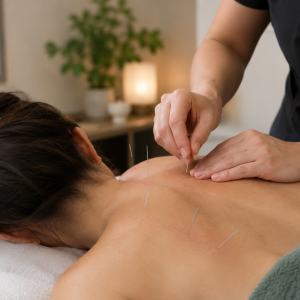
If you’ve ever experienced dry needling, you may have noticed something unexpected.
The needle is placed into a tense area, and suddenly the muscle makes a small, involuntary twitch.
It can feel strange.
Sometimes it’s barely noticeable. Other times, it feels like a quick jump or brief contraction beneath the skin.
So what’s happening?
This response is commonly referred to as a local twitch response, and it’s a phenomenon that practitioners may observe when dry needling certain areas of muscle.
It isn’t your body “fighting” the needle.
And it doesn’t mean the treatment is only working if you experience a twitch.
Let’s take a closer look at what this response actually means.
What Is a Local Twitch Response?
A local twitch response is a brief, involuntary contraction of a muscle that can occur when a needle stimulates a sensitive area within muscle tissue.
It may happen when dry needling is directed toward what a practitioner identifies as a trigger point or taut band of muscle.
The movement is typically quick and happens without you intentionally contracting the muscle.
You might describe it as:
- A tiny jump
- A quick spasm
- A brief flicker
- A sudden muscle contraction
- A short “twitch” beneath the skin
The sensation can be surprising, especially if you weren’t expecting it.
But a twitch is not automatically a sign that something is wrong.
Why Does the Muscle Twitch?
Muscles contain many structures involved in sensing and controlling movement.
When a dry needle interacts with certain areas of muscle tissue, it can stimulate local nerve and muscle responses.
The resulting contraction is involuntary.
Importantly, scientists are still studying the exact mechanisms behind local twitch responses and how they relate to the effects of dry needling.
So it’s better to think of the twitch as a physiological response to stimulation, rather than assuming it has one specific meaning.
Why Does a Practitioner Pay Attention to the Response?
During dry needling, a practitioner may observe how the tissue responds to needle stimulation.
A local twitch can provide information about the tissue being stimulated and may be one of several responses the practitioner considers during treatment.
However, the goal isn’t simply to make a muscle twitch.
A skilled practitioner considers the entire clinical picture.
That can include:
- Where you experience discomfort
- How you move
- Muscle tension
- Range of motion
- Your symptoms
- Your medical history
- How your body responds during treatment
The twitch is only one piece of information.
Is a Bigger Twitch Better?
No.
A larger or more noticeable twitch doesn’t automatically mean a better treatment.
This is an important misconception to clear up.
Dry needling isn’t a competition to see how much a muscle can react.
Some muscles may twitch.
Others may not.
Your response can vary depending on the muscle, technique, location, and individual factors.
No twitch does not mean no treatment effect.
And a strong twitch doesn’t necessarily mean the treatment was more effective.
What Does the Twitch Feel Like?
Everyone experiences dry needling differently.
A local twitch may feel like a sudden flick or quick cramp.
Some people describe it as surprising more than painful.
Others may experience temporary soreness afterward, similar to the feeling you might have after exercising a muscle.
Your practitioner should explain what you may experience before beginning treatment and should adjust the approach based on your comfort and individual needs.
If something feels excessively painful or uncomfortable, let your practitioner know.
What Happens After the Twitch?
The muscle may feel different immediately afterward, although responses vary from person to person.
Some people report that an area feels less tense or easier to move.
Others may experience temporary tenderness following treatment.
Post-treatment soreness can occur with dry needling and may last for a short period.
Following your practitioner’s aftercare recommendations can help you understand what to expect and how to care for the treated area.
Dry Needling Isn’t About “Releasing a Knot”
You’ve probably heard phrases like:
“The needle releases the knot.”
That’s an easy way to describe the experience, but the underlying physiology is more complicated.
Dry needling involves mechanical stimulation of tissues using a thin needle.
The effects may involve local and nervous-system responses, and researchers continue to investigate the mechanisms responsible for the clinical effects of dry needling.
It’s therefore more accurate to say that dry needling stimulates specific tissues and may influence pain and muscle function, rather than claiming that it physically pulls a knot out of the muscle.
How Dry Needling Fits Into a Bigger Treatment Plan
Dry needling can be used as one component of a broader approach to musculoskeletal care.
Depending on your individual situation, treatment may also involve:
- Movement exercises
- Strengthening
- Mobility work
- Stretching
- Postural awareness
- Activity modification
- Other forms of manual therapy
The goal isn’t simply to temporarily change how a muscle feels.
Ideally, treatment considers why the area is having difficulty in the first place.
Dry Needling vs. Acupuncture
Dry needling and acupuncture both use very thin needles, but they aren’t the same practice.
Dry needling is generally used within a musculoskeletal framework, often targeting muscles and areas of muscular pain or dysfunction.
Acupuncture is rooted in traditional Chinese medicine and uses acupuncture points within a broader traditional medical framework.
The techniques, clinical reasoning, and treatment philosophies can differ.
If you’re unsure which approach is appropriate for your goals, a qualified practitioner can help explain your options.
Does Dry Needling Hurt?
There can be some discomfort with needle insertion or stimulation, but experiences vary considerably.
You may feel:
- A brief prick
- Pressure
- A small muscle twitch
- Temporary soreness
- A sensation of heaviness or aching
The experience depends on the technique, treatment area, and individual sensitivity.
You should always communicate with your practitioner throughout the session.
You don’t need to endure unnecessary pain for dry needling to be effective.
Is Dry Needling Safe?
When performed by an appropriately trained and qualified practitioner using proper technique and sterile equipment, dry needling is generally considered a low-risk procedure.
However, like any procedure involving needles, it carries potential risks.
These can include temporary soreness, bleeding, bruising, and, more rarely, infection or other complications.
Certain areas of the body require particular caution because of underlying anatomy.
This is why proper training, anatomical knowledge, screening, and technique are essential.
Always inform your practitioner about relevant medical conditions, medications, pregnancy, recent procedures, or other factors that may affect whether dry needling is appropriate for you.
The Twitch Is Only Part of the Story
That little muscle jump can certainly get your attention.
But it isn’t the whole point of dry needling.
The twitch is simply one physiological response that can occur when specific muscle tissue is stimulated.
What matters more is the bigger picture:
Why is the muscle tense?
How is it affecting your movement?
What might be contributing to the problem?
What does your body need beyond today’s treatment?
At Art of Healing, dry needling can be part of an individualized approach to muscular tension, movement, and pain management.
A twitch may be noticeable.
But understanding why your body is responding the way it is can be even more valuable.
Your muscles are constantly communicating. Sometimes, that tiny twitch is simply one way they’re responding to being heard.
Follow Us