
Have you ever had the same muscle feel tight over and over again—even after stretching, resting, or getting a massage?
Sometimes the problem isn’t that the muscle simply needs more rest.
It may be working harder than it was designed to because other muscles aren’t contributing enough.
Your body is constantly trying to keep you moving and stable. When one area becomes weak, restricted, injured, or fatigued, other muscles may step in to compensate.
At first, this adaptation can be helpful.
But when it continues for too long, certain muscles may rarely get the opportunity to fully relax.
What Does It Mean for a Muscle to Be Overworked?
Muscles don’t only work when you’re exercising.
They’re active when you stand, walk, sit, type, drive, balance, and even maintain your posture.
Some muscles are designed to provide ongoing stability. But if they are consistently asked to do more than their usual share of the work, they can become fatigued and tense.
You might notice:
- Persistent tightness
- Muscle soreness
- Reduced flexibility
- Tender spots
- A feeling of heaviness or fatigue
- Discomfort during certain movements
- One side feeling different from the other
The uncomfortable area isn’t always the original source of the problem.
It may simply be the area doing the most work.
Why Stretching Doesn’t Always Solve the Problem
Stretching can feel good when a muscle is tight.
But if the muscle keeps becoming tight again, it’s worth asking why.
If another part of the body isn’t providing adequate support, the same muscle may continue compensating.
For example, repeatedly stretching a tight area may provide temporary relief, but the underlying movement pattern may remain unchanged.
This is why effective treatment often involves looking beyond the location of discomfort.
Instead of asking only:
“Where does it hurt?”
a practitioner may also consider:
“Why is this area working so hard?”
What Are Trigger Points?
A trigger point is a sensitive area within muscle tissue that may be associated with localized tenderness and sometimes referred discomfort.
These areas can develop in muscles that are repeatedly overloaded or exposed to sustained tension.
You may notice a particular spot that feels especially tender when pressure is applied.
However, not every painful or tight area is a trigger point, and muscle pain can have many different causes.
A qualified practitioner can help determine whether dry needling is appropriate.
How Dry Needling May Help
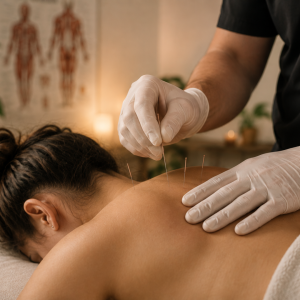
Dry needling is a technique that uses very thin, sterile needles inserted into specific areas of muscle and soft tissue.
Depending on the approach and the individual, treatment may target areas of muscular tension or trigger points.
The purpose isn’t simply to “stick a needle into a sore muscle.”
The practitioner considers the muscle, surrounding tissues, movement patterns, and your specific symptoms when determining where treatment may be appropriate.
Dry needling may be used as part of a broader treatment plan designed to support:
- Muscle relaxation
- Comfortable movement
- Mobility
- Recovery
- Management of muscular tension
Dry Needling Is Different From Acupuncture
Although both techniques use thin needles, they are based on different frameworks and are typically used for different purposes.
Dry needling generally focuses on musculoskeletal structures such as muscles and trigger points.
Acupuncture is rooted in traditional Chinese medicine and uses specific acupuncture points as part of a broader traditional framework.
Both can be offered in a wellness setting, but they aren’t interchangeable treatments.
A qualified practitioner can help determine which approach may be appropriate for your goals.
Movement Matters After Treatment
Addressing muscle tension is only one part of the picture.
How you move afterward can also matter.
Depending on your individual situation, a practitioner may recommend appropriate movement, stretching, strengthening, or activity modifications to support the changes made during treatment.
This is particularly important when muscular tension is connected to repetitive habits or compensation.
Your body needs opportunities to learn a different movement pattern—not simply temporary relief.
A Whole-Body Approach to Muscle Tension
Persistent muscle tension doesn’t always have a single cause.
At Art of Healing, dry needling can be considered alongside other services that support physical and whole-body wellness.
Massage Therapy
Can help address areas of muscular and soft-tissue tension.
Acupuncture
Offers a different approach to whole-body wellness and may complement relaxation and recovery.
Cupping
May be incorporated into care focused on muscular tension and circulation.
Movement and Exercise
Appropriate strengthening and mobility work can help address the movement patterns that contribute to recurring tension.
The right combination depends on the individual.
Sometimes the Tight Muscle Isn’t the Real Problem
When the same muscle keeps tightening, it’s easy to assume it simply needs more stretching.
But your body is more interconnected than that.
A muscle may be tight because it’s compensating, stabilizing, or working harder than other muscles around it.
Understanding why that muscle is working so hard can be just as important as addressing the tension itself.
At Art of Healing, dry needling can be part of a personalized approach that looks beyond one uncomfortable spot and considers how your muscles and movement work together.
Your body doesn’t need every muscle to work harder. Sometimes it needs the right muscles to share the work.
Follow Us