
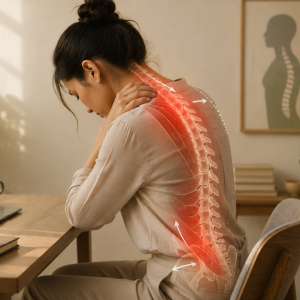
Posture isn’t simply about sitting or standing up straight. It’s about how your muscles, joints, fascia, and nervous system work together to support you throughout the day.
The problem is that your body is remarkably good at adapting.
If you spend hours leaning toward a computer, looking down at your phone, driving, or repeatedly favoring one side of your body, your muscles gradually begin adjusting to those positions. What feels normal may actually be a pattern of compensation.
Over time, these adaptations can contribute to muscle imbalances, stiffness, tension, and changes in the way you move.
Understanding this connection is an important part of taking better care of your body.
Your Body Is Constantly Adapting to How You Move
Your posture isn’t fixed.
It changes when you walk, sit, exercise, sleep, work, and even when you’re stressed.
When a particular position becomes part of your daily routine, your body may begin using certain muscles more than others.
For example, spending long periods at a desk may encourage the head and shoulders to move forward. Some muscles may remain shortened and active, while others have to work harder to stabilize the body.
The result isn’t necessarily one “bad” muscle. It’s often a relationship between muscles that aren’t sharing the workload evenly.
What Are Muscle Imbalances?
Muscle imbalance occurs when certain muscles become stronger, tighter, weaker, or more active than others in a way that affects movement.
These imbalances can develop from:
- Prolonged sitting
- Repetitive movements
- Previous injuries
- Lack of movement
- One-sided activities
- Poorly balanced exercise routines
- Everyday habits and work positions
You may not notice the imbalance immediately.
Instead, you might gradually experience tightness in your neck, aching shoulders, lower-back discomfort, or reduced flexibility.
How Posture Can Affect the Rest of Your Body
One of the most important things to understand about posture is that the body works as a connected system.
A change in one area can influence movement elsewhere.
Forward Head and Neck Position
When the head moves forward for prolonged periods, the muscles around the neck and upper back may have to work harder to support it.
This can contribute to neck and shoulder tension.
Rounded Shoulders
A consistently forward shoulder position can affect the muscles around the chest, upper back, and shoulder blades, potentially changing how the shoulders move.
Sitting for Long Periods
Extended sitting can reduce movement through the hips and place additional demands on surrounding muscles, including those supporting the lower back.
These patterns don’t mean that one posture is inherently harmful. Duration, repetition, movement variety, and individual factors all matter.
Why Your Body May Feel Stiff Even When You Aren’t Injured
Sometimes stiffness isn’t caused by a single injury.
It can develop because your body has become accustomed to moving in a particular way.
When certain muscles remain active for long periods, they may feel tight or fatigued. Other muscles may not be contributing as effectively.
This can make ordinary movements feel less comfortable.
You might notice that:
- Turning your head feels restricted
- Your shoulders feel heavy
- Your hips feel tight after sitting
- Your back feels stiff when you stand
- One side of your body feels different from the other
These sensations are useful information—not necessarily something to simply push through.
Stress Can Make Postural Tension Worse
Posture isn’t only influenced by physical habits.
Stress can change the way you hold your body.
When you’re under pressure, you may unconsciously raise your shoulders, tighten your jaw, hold your breath, or brace your abdominal muscles.
If this happens repeatedly, your body may begin spending more time in a state of tension.
This is one reason physical and emotional wellness are so closely connected.
How Massage Therapy Can Support Healthier Movement
Massage therapy can be a valuable part of caring for muscles affected by repetitive postural habits.
A personalized massage session may help address areas of soft-tissue tension, encourage circulation, and support comfortable range of motion.
Rather than simply treating the area that feels sore, a skilled practitioner can consider the broader movement pattern.
For example, shoulder discomfort may involve tension through the neck, upper back, chest, or surrounding tissues.
The goal is to help your body feel more balanced and supported—not simply to chase the location of discomfort.
Movement Matters More Than Perfect Posture
One of the biggest misconceptions about posture is that there is one perfect position you should maintain all day.
There isn’t.
Your body is designed to move.
A better goal is to change positions regularly and give your body different movement experiences throughout the day.
Try:
- Standing up regularly during long periods of sitting
- Changing your workstation position
- Taking short walking breaks
- Moving your shoulders and neck gently
- Strengthening the muscles that support your daily activities
- Avoiding staying in one position for hours at a time
Healthy posture is less about holding yourself perfectly and more about having the strength, mobility, and awareness to move comfortably.
A Holistic Approach to Posture and Movement
Because posture involves more than individual muscles, different therapies can complement one another.
Massage Therapy
Helps address soft-tissue tension and support comfortable movement.
Acupuncture
May complement relaxation, circulation, and overall nervous-system wellness.
Dry Needling
Can be useful for addressing specific muscular trigger points and areas of persistent tension when clinically appropriate.
Cupping Therapy
May support circulation and help relieve areas of soft-tissue tightness.
At Art of Healing, these approaches can be incorporated into a personalized wellness plan based on your individual needs.
Listen to the Patterns Your Body Is Showing You
Your body often adapts quietly.
A shoulder that gradually becomes tighter. A hip that feels less mobile. A neck that constantly wants to be stretched.
These changes can be easy to dismiss until they begin affecting everyday movement.
Instead of waiting for discomfort to become severe, consider what your body may be telling you.
Sometimes improving movement isn’t about correcting one isolated problem. It’s about understanding the patterns that developed over time and giving your body better opportunities to move, recover, and rebalance.
Your Posture Is a Reflection of How You Move Through Life
Your body doesn’t suddenly develop a movement pattern overnight. Many changes happen gradually through repetition, stress, injury, work habits, and everyday routines.
The good news is that your body is also capable of adapting in healthier directions.
At Art of Healing, our approach looks beyond isolated areas of tension to consider the connection between muscles, movement, stress, and whole-body wellness. Massage therapy, acupuncture, dry needling, and cupping can each play a role in supporting your body’s natural ability to move and recover.
If your body has been feeling different lately, it may be worth listening to what it’s telling you.
Follow Us