
Sometimes a headache arrives after a long day at your computer.
Other times, it appears after hours of concentrating, rushing between responsibilities, or carrying more stress than you realized.
You might notice pressure around your forehead, tightness around your temples, or tension traveling from your neck and shoulders toward your head.
It’s easy to reach for something to make the discomfort disappear.
But sometimes, your body may also be giving you another message:
You may need to slow down.
Tension headaches can have many possible causes, and not every headache is related to stress. However, stress, muscle tension, poor posture, fatigue, and other factors can contribute to headaches for some people.
Understanding those patterns can help you become more aware of what your body may be asking for.
What Is a Tension Headache?
Tension-type headaches are among the most common types of headaches.
They are often described as a feeling of pressure, tightness, or a band-like sensation around the head rather than the throbbing pain commonly associated with migraine.
Some people may also experience tenderness or tension around the scalp, neck, shoulders, or jaw.
Triggers can vary from person to person and may include:
- Stress
- Fatigue
- Poor sleep
- Prolonged computer or screen use
- Eye strain
- Poor posture
- Muscle tension
- Skipping meals
- Dehydration
A headache can have multiple contributing factors, which is why noticing your individual patterns can be useful.
Your Nervous System Doesn’t Always Know When the Day Is Over
Imagine spending the entire day moving from one demand to another.
Emails.
Deadlines.
Traffic.
Meetings.
Family responsibilities.
Notifications.
Even when you finally sit down, your mind may still be running.
Your body can have difficulty transitioning from “I need to keep going” to “I can rest now.”
That doesn’t mean your nervous system is malfunctioning.
It’s responding to the environment and signals it receives.
But if your days rarely include moments of genuine recovery, you may begin to feel the effects through fatigue, muscle tension, difficulty relaxing, or headaches.
The Neck and Shoulders Can Be Part of the Picture
Your head doesn’t exist separately from the rest of your body.
The muscles of your neck, shoulders, upper back, and jaw are involved in posture and movement and can become tense during periods of stress or prolonged positioning.
Think about how you sit when you’re focused on a screen.
Your head may move forward.
Your shoulders may rise.
Your upper back may become rounded.
Your jaw may tighten.
Holding that position for a long time can place additional demands on muscles that were never meant to remain tense indefinitely.
Sometimes your headache is a reason to look beyond your head.
Where Acupuncture Fits Into the Conversation
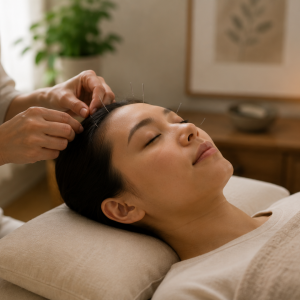
Acupuncture is a traditional practice that involves the insertion of very thin needles into specific points on the body.
Some people seek acupuncture as a complementary approach for managing tension, stress, and certain types of headaches.
Research has found that acupuncture may help reduce the frequency of tension-type headaches for some people, although results can vary and acupuncture isn’t appropriate for every individual.
It should be viewed as a complementary healthcare option rather than a replacement for medical evaluation when a headache is new, severe, persistent, or concerning.
At Art of Healing, acupuncture can be incorporated into a broader approach that considers your overall patterns rather than focusing only on where you feel discomfort.
Acupuncture Isn’t Just About Where Your Head Hurts
One of the interesting things about acupuncture is that treatment doesn’t necessarily focus only on the area where symptoms are experienced.
A practitioner may consider your overall health, physical tension, lifestyle, stress levels, and other factors when developing an individualized treatment approach.
This reflects a broader principle of holistic care:
The place where you feel discomfort isn’t always the only place worth paying attention to.
Your neck, shoulders, posture, sleep, stress, and daily habits may all be relevant pieces of the picture.
A Headache Can Be a Reminder to Check In
The next time you experience tension around your head or neck, instead of immediately pushing through it, take a moment to check in.
Ask yourself:
Have I been holding my shoulders up?
Am I clenching my jaw?
When did I last take a real break?
How did I sleep last night?
Have I been staring at a screen for hours?
Have I been carrying more stress than usual?
Sometimes the answer will be obvious.
Sometimes it won’t.
Either way, your symptoms deserve attention rather than simply being ignored.
When a Headache Needs Medical Attention
Not every headache should be attributed to stress or tension.
Seek urgent medical care for a headache that is sudden and extremely severe, especially if it feels like the worst headache you’ve ever experienced, or if it occurs with symptoms such as weakness, numbness, confusion, fainting, trouble speaking, vision changes, fever with a stiff neck, or other concerning symptoms.
You should also speak with a healthcare professional if headaches are becoming frequent, changing in pattern, worsening, or interfering with your daily life.
Understanding stress and tension can be helpful, but it shouldn’t lead you to overlook a potential medical cause.
Maybe Your Body Is Asking for a Pause
Your body doesn’t always communicate through obvious signals.
Sometimes it whispers through tight shoulders.
Sometimes through a clenched jaw.
Sometimes through fatigue.
And sometimes through the pressure building behind your eyes after another long day.
A headache isn’t necessarily your body’s way of telling you to stop everything. But it can be an opportunity to pause and ask what has been happening in your life, your body, and your daily routine.
At Art of Healing, acupuncture can be part of a personalized, whole-body approach to wellness and tension management.
You don’t always have to push through. Sometimes, slowing down is part of taking care of yourself.
Follow Us